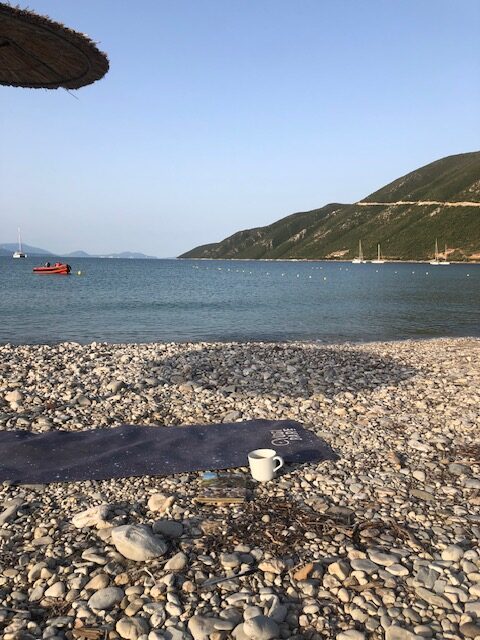
I’m on a beautiful island called Lefkadas, near Ithaka (the name of one of my favourite poems, so beautiful, evocative – and a good reminder of how to live fully). It’s hot! My kids and husband are sleeping like teenagers, as seemingly everyone else. Even at 8am there’s barely anyone around. I’m loving quietly making my coffee, slipping on my shorts and creeping down to the beach on my own. First thing in the morning, the sea is almost completely still, clear and array of barely describable colours. Clear by the shore and then translucent green-blue – like frosted sea glass. Barely a ripple further out in the lapis lazuli mid depths and then in the deep, indigo silk, becoming almost obsidian out at the hazy horizon. At the shore, the wavelets lap rhythmically on white pebbles. I’ve been tuning my breath into the ebb and flow of these little waves. It’s not perfect, but it’s a lovely way to anchor my awareness deeply into my breath. I’ve been imagining the flow of water back and forth, like the breath of the ocean. As though each wavelet up the beach is an exhale of the ocean, stretching the water away from its home. Each time the waves flow back into their home body of water, like an inhale, the ocean filling itself back up. I’ve been playing with imagery of this and I love it. It also works the other way around, the inhale moving up the beach, the exhale moving back to the sea. I know Greek mythology disagrees with me, but I always imagine the ocean, like the earth, as female.
If you’re near the sea anywhere in the world this summer, perhaps you’ll enjoy spending a few moments tuning into your breath and connecting with the ocean (and your own inner currents) in this way. Best in calmer waters!
If you’re intrigued, traditional ujjayi breath, sometimes known as ocean breath, or even Darth Vader breath (!) is a lovely way to set an audible rhythm to your breath for physical or meditative practices. It is considered calming and soothing to the nervous system because it slows the breath down by a slight constriction in the back of the throat – hence the sound – like ocean waves or Darth Vader.
Give it a try by starting the exhale with an open mouth, making the sound you would make if you were to fog a mirror. It’s a haaaaaa kind of sound. Sounds (a bit) like the ocean. Or Darth Vader. Notice the slight narrowing of the back of the throat. Once you feel fairly comfortable with that exhale, try doing it on the inhale. Tricky but not impossible. You might find it easier to try with the mouth closed and inhale through the nose, then exhale through an open mouth. Or try both through the nose. Try breathing in this way for a couple of minutes and see what you think. Or, if you like my idea, try visualising gentle beach waves, calmly ebbing and flowing and match your breath to this idea of ‘ocean breathing’.
Look out for my new posters and programmes coming to your local area and your inbox in a couple of weeks.
Massage resumes w/c 3rd August and the Monday & Tuesday are already fully booked – book for the rest of that week and until the end of August here.
Love and rest, Katie xx
PS Tell me, have you seen the new movie, The Odyssey? I love a Greek epic and am looking forward to seeing it when I’m home. Let me know what you thought!
Also – if you want a greater sense of that connection with yourself, remember to sign up for this free zoom: “Breath, body and a little psychology” – co-led by me and Dr Kristin Bohn, 8 – 9pm, Weds 16th September
“May you recognise in your life the profound invitation that comes with each new dawn” — John O’Donohue
Beautiful, nervous system supporting, seasonal retreats to help you flourish co-led by two expert practitioners. With over 40 years of professional experience in women’s wellbeing, together we hold space and create experiences with integrity, professionalism and deep human compassion.
Yoga, movement, nutrition and bodywork is led by Katie. Dr Kristin Bohn, Clinical Psychologist and Positive Psychology Coach provides with science-backed practices to supporting a life aligned with your values. Full details of our seasonal retreats are below.
Our autumn retreat: Turning Home ~ Friday 2nd October 9.30 – 1.30pm
As the seasons soften and the air turns, this nurturing autumn retreat invites you to slow down, reconnect, and choose how you want to move forward – with haste and hurry or choice and intention?
Including practices to awaken the senses to the beauty of the season — the scent of fallen leaves, cool fresh air, changing colours and earthy stillness. You’ll learn practices of grounding, presence and awareness – tools to take away and weave into the months ahead, allowing you to engage fully in the moment.
Through gentle movement, deep rest and calming rituals, Katie supports you to release tension you didn’t know you were holding and leave you with a sense of deep nourishment. Stocking your larder with replenishing energy for the months ahead.
Dr Kristin Bohn will guide you in a simple, research-based practice for noticing and holding on to the good — the small, easily-missed moments that, once we learn to pause with them, can gently shift how we feel.
Together, we’ll reflect on the seeds we wish to nurture for the coming year, allowing intentions to softly ruminate over winter, without pressure or urgency.
Thoughtfully curated and deeply replenishing, Turning Home offers a gentle invitation to return to yourself — feeling calmer, steadier, and more rooted as the seasons begin to change. Book here under “half day retreats”.
In the depths of midwinter, this deeply restorative retreat offers space to stop, rest, and retreat from the busyness of everyday life. Pressing pause on the normal expectations of this time of year, recalibrating and replenishing body, mind and soul as you turn inward, nourishing yourself.
Inspired by the slower rhythms of winter, the day is designed to nourish your nervous system through slow somatic movement, grounding practices, intentional rest and gentle reawakening of your senses and direction. There is nothing to chase here but space created and held to listen inwardly. If that feels impossible with the busy-ness of our brain, don’t worry, you’ll be guided deeply by two expert practictioners withcollectively over 40 years expertise.
Body and breath practices are led by Katie, known for her deep nurturing, inclusive and accessible approach. Dr Kristin Bohn will share gentle, evidence-based practices around self-compassion — how treating yourself with the same kindness you so readily give others can quietly steady you through the darker months. Book here under “half day retreats”.
Are these women’s retreats right for you?
You sense that something is shifting — in your body, your priorities, your sense of self
You are tired in a way that a holiday doesn’t fix
You have been the one holding everything together and you are ready, just for a morning, to be held
You are curious about what comes next, but haven’t had the space or silence to hear the answer
You have never done anything like this before and you are a little nervous and also quietly sure it’s exactly what you need
No yoga experience required. No flexibility required. Everything you need is provided — mats, bolsters, blankets, eye pillows, snacks and drinks. You just bring yourself.
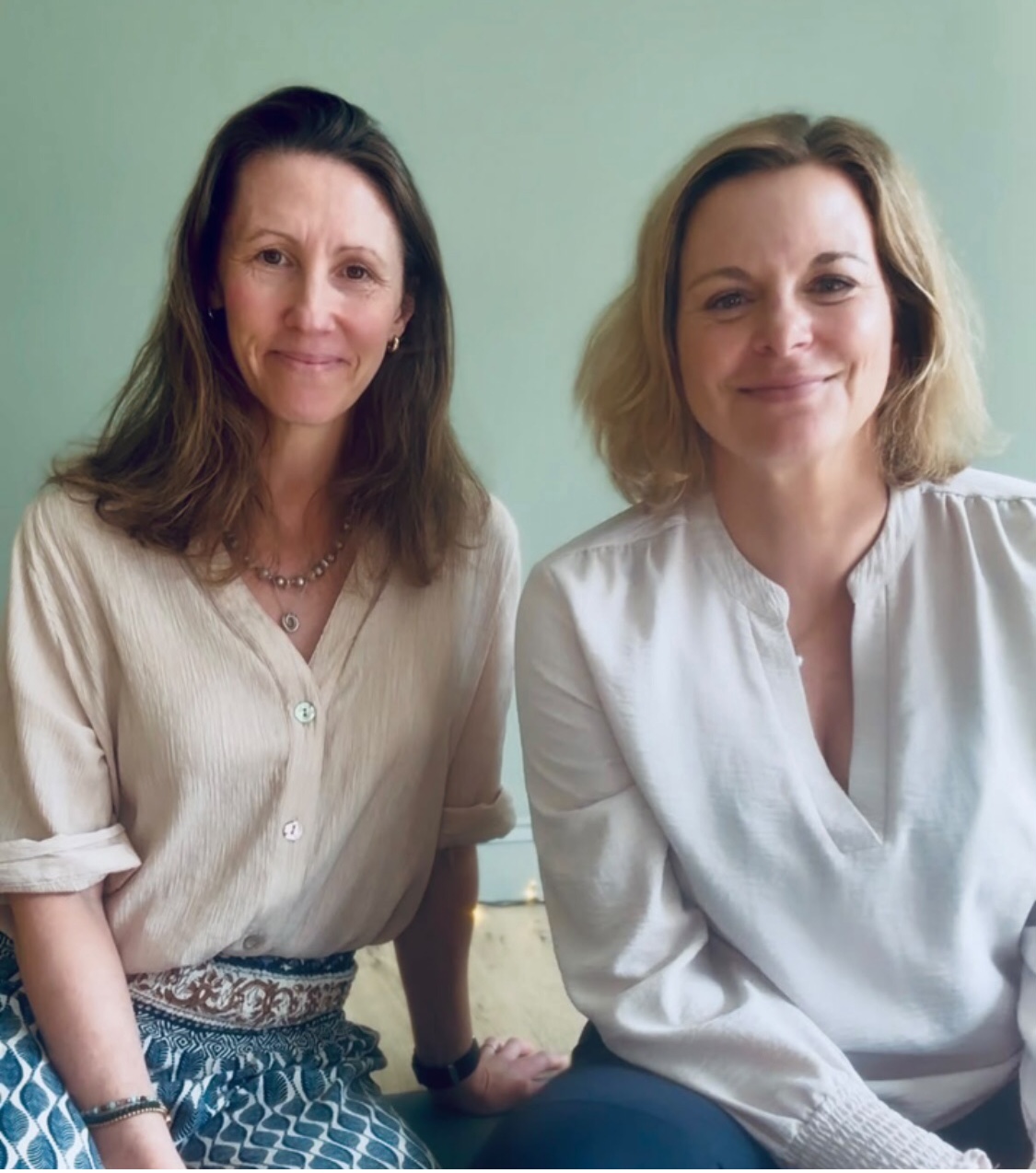
Your hosts, Katie Wheater & Dr Kristin Bohn
Your Oxford retreat facilitators
Katie Wheater is a yoga teacher, nutritionist and massage practitioner based in Oxford, specialising in women’s wellbeing, nervous system regulation, and the particular needs of midlife women’s bodies. She has been working with women in this way for years — and her cabin, her garden, and her hands have held a great many of them.
Dr Kristin Bohn is a Clinical Psychologist and Positive Psychology Coach. Her work is grounded in the science of wellbeing, human flourishing, and what it means to live a life aligned with your deepest values. She brings warmth, precision, and a rare capacity to hold both the complexity and the possibility of midlife.
Pricing & how to book
Early bird pricing: each retreat is £100, price increase to £125 three weeks before the event. Get in touch with either of us by email with any questions at all: katie@katiewheaterwellbeing.co.uk or drkristinbohn@gmail.com or BOOK HERE under half day retreats.
Your shoulders called, they want you to take some action!
Sore, tight, tense shoulders. The biggest reason women seek out a massage, in my experience. As both a massage therapist and yoga teacher, I’m in a unique position to make suggestions on how to help your aching shoulders. So, if you can’t get a massage appointment as soon as you’d like, here are my top tips on self help for shoulder ache.
Heat is my number one go to: lie on a hot water bottle or get in a warm-hot bath with your shoulders under the water. If you’re not a fan of heat, move on to step 2. If you can warm up your shoulders first, the muscles will likely respond faster to the steps below
Pass the yoga block, or as you’re unlikely to have one at home, any brick sized book will do – Harry Potter or the dictionary are perfect. I really recommend a soft back version so it makes less noise when you inevitably drop it on the floor! Reach your left arm behind you as though you are about to unclip your bra. Taking the book in your right hand, reach over head and pass the book to your left hand. Switch arms. Repeat a few times. And then reverse. It’ll feel super weird. And likely harder on one side than the other. Hence you’ll probably drop the book. It feels weird because it’s probably not a movement you’ve done before, and as a result, the brain is having to work! This is great because not only are we creating space in the shoulders, but also space in the brain by forcing new neural pathways to be made!
Take a belt or scarf. Holding in front of your in your hands, widen your hands so that they are 10 – 15cm wider than shoulder distance apart on each side. Begin to raise your arms towards the ceiling, holding the belt/scarf. Maybe your knuckles point towards the ceiling, maybe they don’t. Wherever you are, begin to make little, gentle forwards-backwards movements with your hands enabling the shoulders to open and “floss”. With practice, you may be able to/want to bring the hands closer together and increase how far back you can move the arms. Work with and listen to your body. What’s right for you will be different to others in your household. Go gently.
Put two tennis balls in a clean sock and tie the end with a hair/elastic band. You want to be able to slightly separate the tennis balls with a gap of approx 2cms between them. This sounds extremely weird to support the shoulders but it really works. The key point is GO GENTLY. We are not trying to immediately work through any knots and tightness but to GENTLY ease into muscular and myofascial tightness here. Lie down on a carpet / yoga mat and ease the tennis balls under your neck. The balls should be either side of the spine and AT NO POINT should they be resting on the spine – this is why you have a gap between them. Adjust the tennis balls to ensure they are not resting on the spine or any other bone such as the shoulder blade. Slowly ease onto the tennis balls, which are pressing into the top of your trapezius muscles. Just rest here on the tennis balls and allow your body weight to ease into them. If the sensation is too strong and causing you to grit your teeth, tense up or generally feels too intense, back off. You can do this by supporting you head with a cushion. SLOWLY AND GENTLY roll down the tennis balls so they are an inch further down. Allow the body to ease onto them. Roll down another inch so they are between your shoulder blades. You can keep going all the way down either side of the spine if you like. The key points are:
NEVER ON BONE
GO GENTLY and ease up if the sensation is too intense – no muscling through pain as it just tells your nervous system to brace, which is not helping you to relax or release anywhere!
The sock stops the tennis balls pinging out across the room, trust me, I know!
Don’t spend more than 60 ish seconds in each place. Go slowly and see how the body responds.
5. Book your massage with an experienced therapist who sees your pain issue as part of a holistic picture and can use a variety of tools to support you.
Why women in Oxford should stop putting off their massage!
There is a particular kind of tension that lives in women’s bodies.
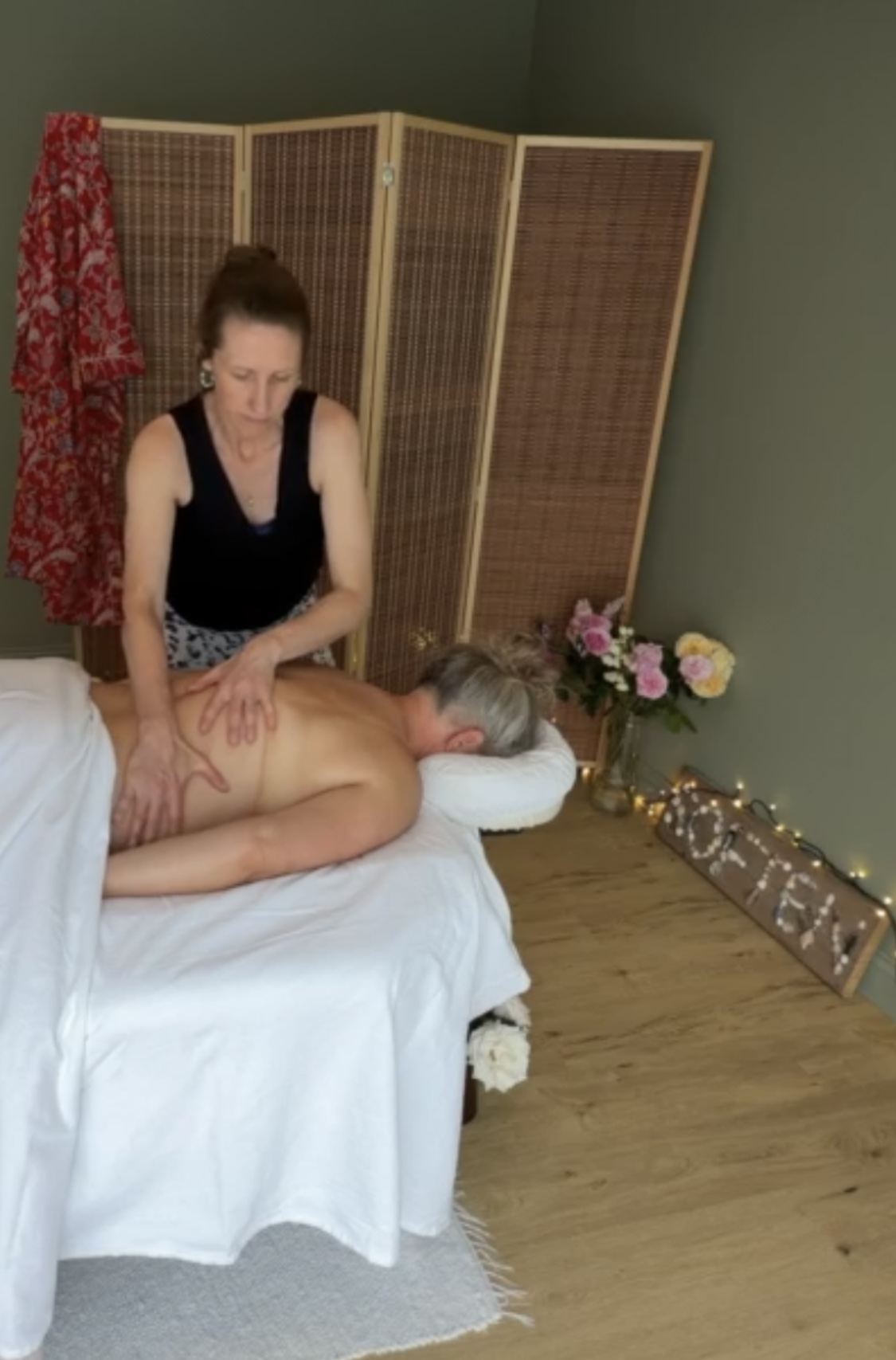
Katie at work in the cabin
It’s in the shoulders, yes. And the neck. But it’s also in the jaw you clench at night, the breath you take but not fully. The way your whole body sort of braces itself, sometimes you don’t even know why or recognise it happening until your shoulders and back start to ache. It’s the accumulated weight of the week, the month, the year — of being the one who keeps track, who holds things together, who is always, always on. It’s just not quite feeling yourself. Maybe it’s hormones – perimenopause? Tiredness? Stress?
Most women I know have been carrying this for so long that they’ve stopped noticing it. It just feels like normal.
It isn’t.
What massage actually does
I want to talk about massage properly for a moment — not as a treat or a luxury, but as something your body genuinely needs.
When you receive a massage, your nervous system shifts from its default state (alert, watchful, ready to respond) into something rarer and more restorative. It’s why your tummy gurgles around 20 minutes in – you’ve entered a restful state – ‘rest and digest’. Your hormones respond. Your heart rate slows. Your muscles — which have been held, braced and guarded — begin to actually let go. Not because you willed them to. But because someone skilled and present helped them find the way.
This matters enormously for women, particularly those of us in the middle part of life, when hormonal changes can make the nervous system more reactive, when sleep is disrupted, when the body is carrying both more responsibility and more change than at almost any other point. Massage is not a nice-to-have in this season. It is, quite honestly, one of the most intelligent things you can do for yourself.
The research backs this up — regular massage reduces anxiety, improves sleep quality, lowers blood pressure, relieves chronic muscle pain, and supports the immune system. But I suspect you don’t need me to cite a paper. I think you already know, somewhere in your body, that you need it.
You’ve probably known for a while.
So, what stops women from booking?
I see the same thing again and again. Women who would book a massage for a friend without hesitation. Women who would encourage anyone else to rest, to be looked after, to invest in themselves. Women who feel vaguely guilty spending money on something that is “just for them.”
Here is what I want to say about that:
You are not a machine that runs on willpower. You are a body — a nervous system, a set of muscles, a hormonal ecosystem — and you need maintenance, care, and sometimes, the ancient and irreplaceable gift of gentle, nourishing, unconditional, caring touch.
You give so much out. This is one of the ways to give back to yourself.
What a massage with me looks like
You arrive at my cabin in Headington, Oxford. I start with a warm foot-bath and a cup of tea — not as a gesture, but because this sets the tone for your experience. For the level of care you’ll receive. It signals to your nervous system that it can begin to relax, that you can begin to relax. Sometimes it’s the simplest things that make a difference to how safe you feel. How much your mind will allow your body to let go. While you soak your feet, we talk. I want to know what’s going on in your body, where you’re holding, what you need.
No two appointments are the same, because no two women — and no two weeks — are the same.
Depending on what you need, I might work slowly and deeply through muscle layers to release what’s been held there for months. I might use myofascial release to untangle the connective tissue that surrounds and supports your muscles. I might use hot stones where the body is particularly resistant to letting go. I might spend time on specific problem areas — the neck, the hips, the lower back — or I might offer something more holistic, something that works on the whole system rather than the parts.
What I am always trying to do is leave you feeling rested, reset, replenished. Reconnected with your body. Like you can breathe properly again.
Women say things like transformational and magical after their appointments. I understand why — because when the nervous system finally releases, when the muscles stop bracing, when you stop holding yourself together for just an hour, the effect is profound. It reaches further than the physical. To really hear what women say about my work, read my independent reviews here.
A little about me
I’ve been working with women’s bodies for more than 14 years – pregnant bodies, tired bodies, bodies of all ages, sizes, shapes. Scarred bodies and those holding on until the point of overwhelm. It’s safe to say, after treating thousands of women, I’ve seen it before – but no body is the same. And this is the beauty of my practice. You’re so much more than a body. I listen to your words – and what your body is telling me silently. I trained originally with the Oxford School of Massage and have continued my professional development both officially through Jing and Jenny Burrell Education, but also through my fascination with anatomy, physiology and how everything is connected. My hobby is reading on these subjects! Alongside my yoga teaching and nutritional work, I specialise in what I think of as the whole woman. Not just the tight trapezius. But the woman underneath it.
I work from my bespoke cabin in Headington — a genuinely beautiful, calm, separate space, hidden in my garden, away from the noise of everyday life.
I offer women’s massage on Mondays, Wednesdays, and Thursday mornings. Appointments are 75 minutes and cost £80.
How to book your Oxford massage
If you recognise something of yourself here — that particular tiredness, that sense of running on empty, that awareness that your body is asking for something — please don’t add it to the list of things you’ll do eventually. Book your massage appointment in Oxford now. Do it as an act of intelligent, intentional self care for yourself, and for everyone who needs you to be present, calm and at ease.
What is it and why it matters for women in Oxford more than you think
Most of us have a self-care habit. We just don’t always recognise it as one. Just because it’s a habit doesn’t always mean it’s helpful….
It might be the scroll through your phone when your morning alarm goes off. The podcast on your daily commute that means you don’t have to sit with your own thoughts. The glass of wine on a Friday that signals — finally, finally — the end of the week. The Netflix series you watch until the early hours – just one more episode… The holiday you work towards for months and then spend half of recovering from exhaustion and the other half dreading coming home, spiralling about that meeting next week…
These things aren’t wrong. They’re human. But they are, almost always, reactive. They happen when we’re depleted and not replenishing. And the problem with reactive self-care — the problem most of us have been living with, with what feels like forever — is that it keeps you functional, but it never quite gets you ahead. You recover enough to go again. And then you go again. And then you recover. And so it continues, for years, until one day the recovery takes longer than it used to. Or stops working altogether.
This is the treadmill that most women I work with in Oxford have been on — often for a very long time.
What I mean when I say ‘self-care‘
The word has become almost meaningless. Self-care now means bath bombs and face masks and branded water bottles. Buying yourself that new top or lip gloss. It means something you buy, something you deserve as a reward, something you do to yourself rather than for yourself.
But the original meaning — the one that actually matters — is simpler and more serious than that. Self-care means the ongoing, conscious practice of attending to your own needs. Physical needs. Emotional needs. Nervous system needs. The need for rest that is genuine rest, not just the absence of activity. The need for nourishment that goes beyond calories. The need, which so many women in midlife feel acutely and can rarely articulate, to be known — including by yourself.
Intentional self-care, as I understand it and as I try to support women in practising it, is what happens when you stop waiting for depletion to force your hand. When you make the decision, in advance and on purpose, that your wellbeing is not a reward for good behaviour or a treat for hard work. It is a baseline requirement. It is the foundation from which everything else — the work, the relationships, the caregiving, the showing up — becomes possible.
What do I do personally? I try to make a few minutes, three times a day, every day to show up for myself. Practically, this looks like:
6.15am (approx): coffee, in my garden, with my cats – non-negotiable. Sometimes it might include a 3 – 5 minute breath or sitting meditation practice, but not alwasy
Before my kids get home: a cup of tea and a 10 minute deep rest yoga nidra recording. A reset of priorities that helps me be genuinely present when they walk through the door.
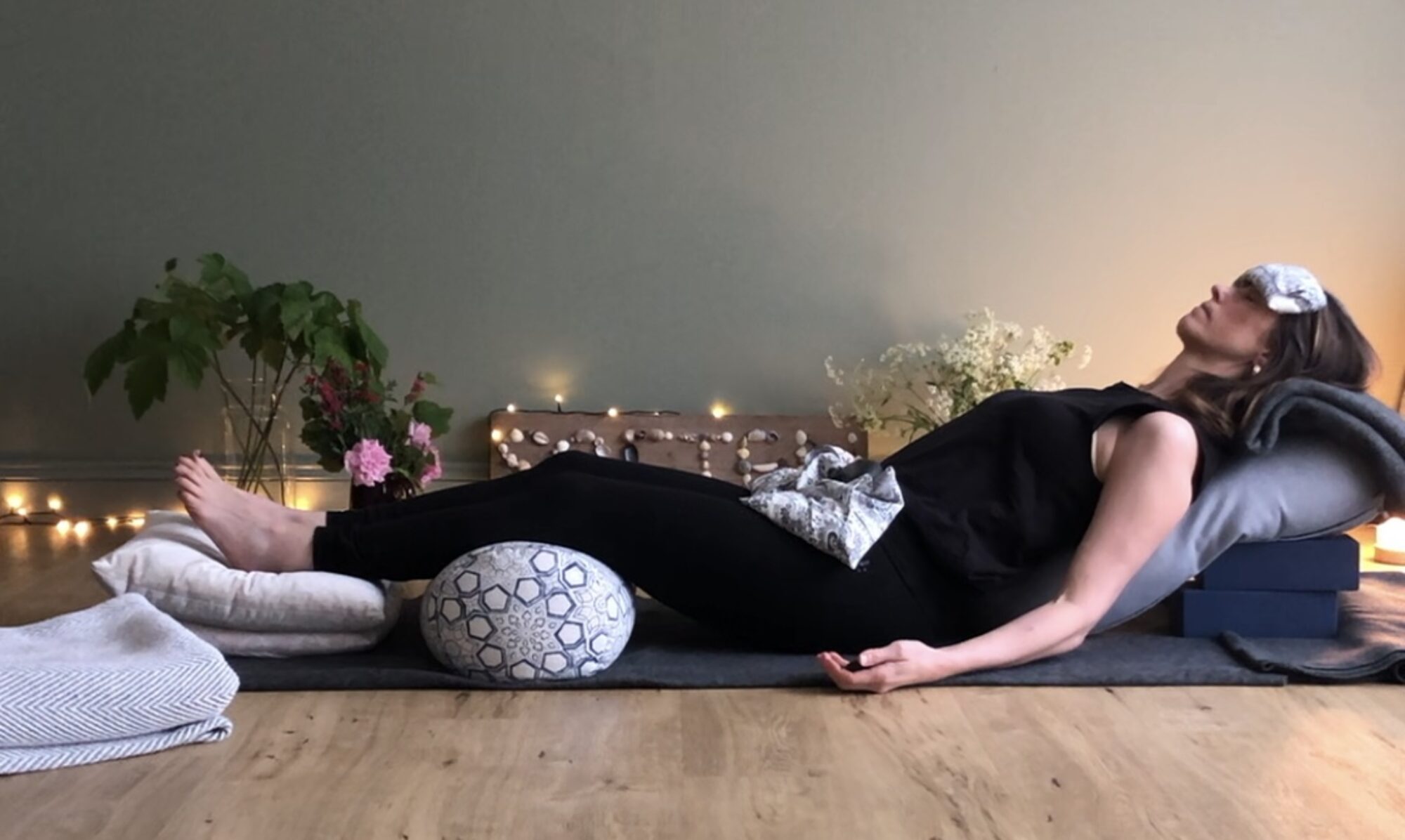
10pm (earlier if I can!): a 10 – 30 minute restorative practice. Usually this involves lying in one position, propped with all the supports (bolsters, weighted pillows, blankets, eye pillows). Just being. Just resting. Letting the day drain away before I even get in bed.
Why women struggle with this
I want to say something honest here, because I think it’s important.
Most women find intentional self-care genuinely difficult — not logistically, but psychologically. There is something in the way many of us were raised that makes it very hard to prioritise ourselves without a qualifier. Without thinking, ‘I deserve this because I’ve been working so hard’. Without ‘I’m doing this so I can be better for everyone else’. Without the guilt that sits alongside any act of self-attention, quietly asking: but shouldn’t you be doing something for someone else right now? Read my blog here on why I think resting is the opposite of lazy.
The trouble with needing a justification is that the justification can always be argued with. There is always more to do. There is always someone who needs something. There is always a reason why now isn’t quite the right time.
Intentional self-care requires something more radical than a justification. It requires a belief — a genuine, embodied belief, not just an intellectual one — that you matter. Not because of what you produce or who you support or how well you hold things together. But simply because you are a person, with a body and a nervous system and a life, and that is enough.
This is, for many women, the actual work. And it is work worth doing.
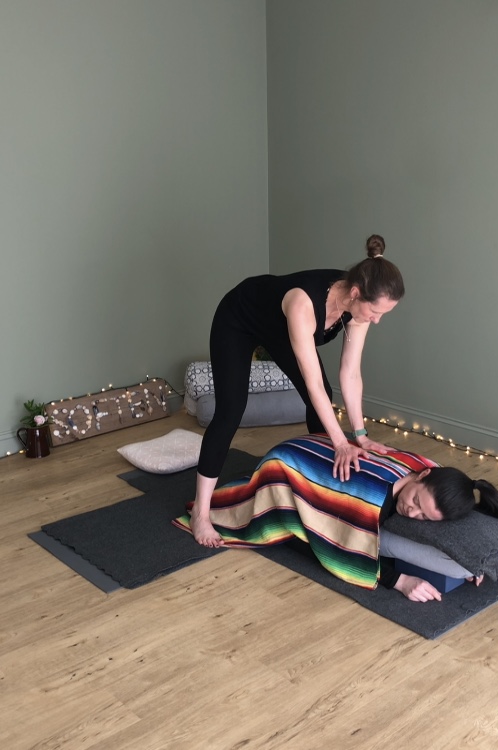
A woman receiving hands-on support during a restorative yoga class with Katie
What the body is trying to tell you
Long before the mind registers burnout, the body is already leaving messages.
The shoulders that never fully drop. The jaw you find clenched in the middle of an ordinary conversation. Or wake up with an ache in your face, having ground your teeth all night. The tiredness that isn’t fixed by sleep. The low-grade anxiety that hums underneath the surface of days that should, by most measures, be fine. The way your body braces slightly — holds slightly — almost all of the time, as though it is perpetually waiting for the next thing to manage.
These are not character flaws. They are physiological responses to sustained stress and insufficient recovery. The nervous system, when chronically activated, begins to operate from a narrowed window — less capacity for joy, for creativity, for ease, for genuine connection. More reactivity. More flatness. More of that particular exhaustion that isn’t about hours of sleep but about being, for too long, too much in the mode of doing and not enough in the mode of being.
The body knows. It has always known. Most women I work with tell me, at some point, that they have known for a long time that something needed to change. They just haven’t had the space, or the permission, or the support, to begin.
What intentional self-care actually looks like
It doesn’t have to be dramatic. In fact, the most sustainable version of it rarely is.
It looks like a weekly yoga class in Oxford that you protect in your diary the way you protect a work meeting — not because it’s serious and effortful, but because it matters and it’s yours. Movement that isn’t about burning calories or improving performance but about coming back into your body, releasing what the week has deposited there, remembering what it feels like to be at home in yourself.
It looks like a regular massage appointment — and I mean regular, not occasional. Not when your back finally gives out. Not as a birthday treat. But as maintenance. As the consistent, skilful attention to a body that is working hard and deserves to be cared for. Massage, like deep rest yoga nidra and restful, restorative yoga, does things that nothing else quite replicates: it shifts the nervous system into a genuinely restorative state, releases tissue that has been chronically held, and creates a particular quality of rest — receptive, passive, held — that most women almost never experience in ordinary life.
It looks like paying attention to what you eat — not in the anxious, restrictive way that the wellness industry often promotes, but with genuine curiosity and care. Food is information for your body. It shapes your hormones, your energy, your mood, your capacity to handle stress. Small, sustainable changes made with understanding have a cumulative effect that can be quietly transformative, particularly for women navigating the hormonal shifts of midlife.
And sometimes it looks like something more immersive — a half-day, a morning, a real pause. Time specifically held for you to slow down enough to hear yourself. To ask the questions that get drowned out by the noise of ordinary life. What am I carrying? What do I actually need? What am I turning towards?
These aren’t luxuries. They’re necessary for living a fullsome and enjoyable, sustainable and well lived life. And the women who make space to ask them — and to sit with the answers — tend to move through the world differently afterwards.
The ripple effect
Here is something I have observed again and again in my work with women: when a woman begins to genuinely care for herself — not reactively, not guiltily, not in the cracks between everything else, but intentionally, as a practice — it changes everything around her too.
Not because she becomes more productive or more useful to others, although that sometimes happens. But because she becomes more present. More spacious. More able to give from a place of genuine abundance rather than thinly stretched obligation. The quality of her attention to her children, her relationships, her work — it shifts. And the permission she gives herself seems, almost magnetically, to give other women around her permission too.
Well-rested, well-nourished, genuinely cared-for women are not a wellness industry fantasy. They are a different kind of force in the world. And I believe — I really do believe this — that the work of supporting women to be that is some of the most important work there is. Which is why I love working with you. Why I ask you to recommend me and tell your friends. I genuinely believe we can create small shifts in the fabric of society through women being well rested, well resourced, in touch with their needs – through intelligent self care.
Where to begin
If you’ve read this far (thank you!), you’ve probably recognised something needs to change.
Maybe you’re already practising intentional self-care and this has named something you’ve been living but not quite articulating. Maybe you’re somewhere in the middle — doing some of it, feeling the pull towards more, but not quite sure where to start or whether you’re allowed to.
Or maybe you’ve been running on empty for a while, and you know it, and something about reading this has made that very clear.
Wherever you are: you don’t have to overhaul everything. You just have to begin somewhere. One class. One appointment. One honest conversation with yourself about what you actually need. Read about all my offerings here and watch yourself, feel yourself, begin to soften.