Part 3: Restful, restorative yoga at home

Many, MANY, years ago when I worked in environmental PR in Old Street in London (not a salubrious place 20 years ago!), I had a boss who used to do this in the middle of the day. I thought she was completely bonkers at the time and seriously unprofessional; although noone else batted an eyelid. In those days, I worked for a very progressive climate change action charity and normal attire was board shorts and flip flops (unless we were meeting clients of course!). New to London and wanting to be good at my job, this was not something I was doing in the office! But it certainly was something I was doing in yoga classes.

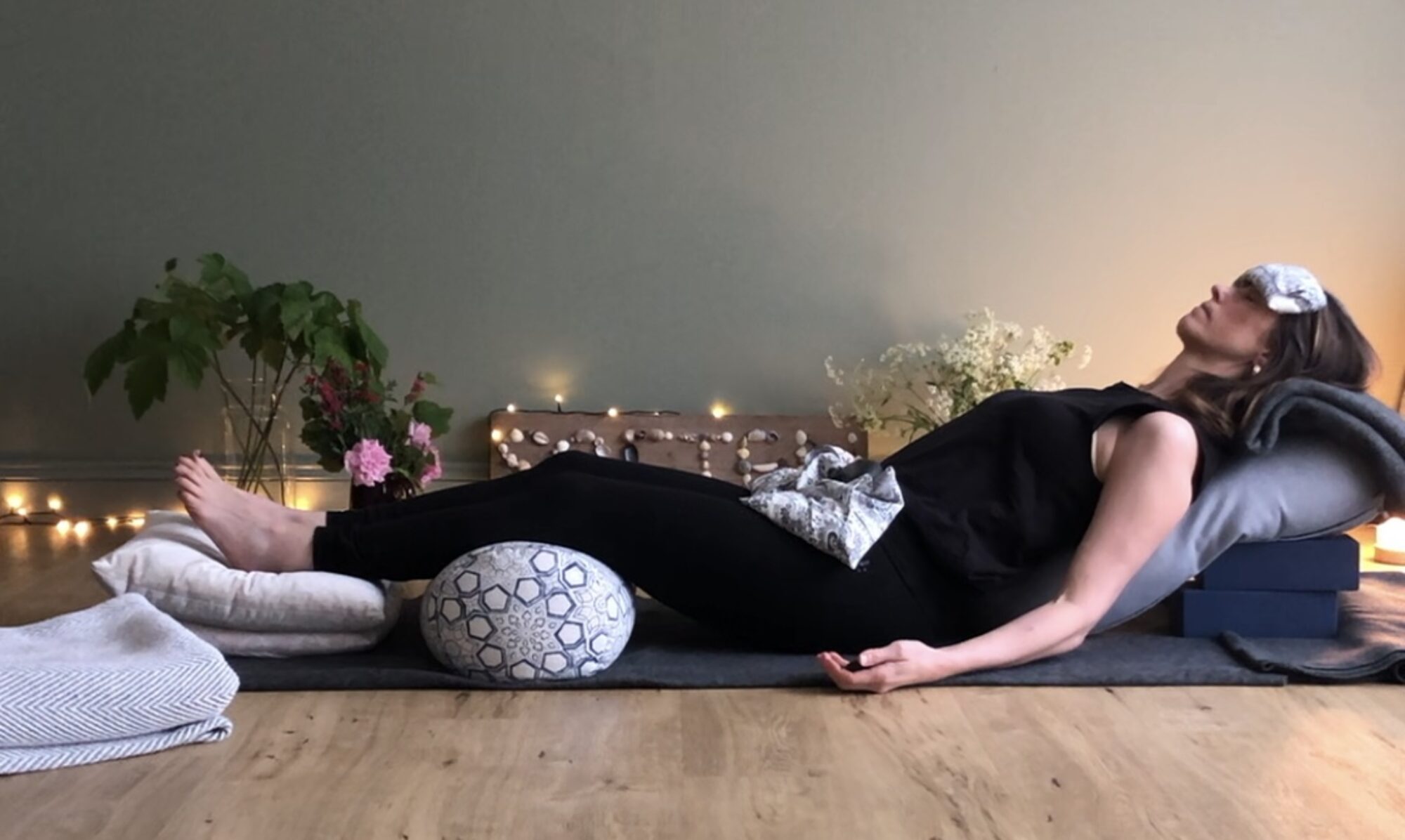
Above is a take on ‘legs up the wall’, aka Viprarita karani in sanskrit. In ‘legs up the wall’ (or kitchen cupboards, bed, sofa, whatever), the idea is to raise the legs above the head, soothing for the nervous system and lowering blood pressure, resulting in generally feeling calmer, more relaxed and ready for sleep.

In this version, I have my lower legs draped over a chair, with a soft blanket beneath my legs, and my torso, and a cushion beneath my head for maximum comfort. If only it was normal to do this before meetings, zoom or real life, we might all be more productive, kinder to each other and less stressed!

Do anywhere breath practice to soothe

You know that feeling when you start to think things are getting on top of you? Whether you’re sat in traffic, waiting in the supermarket queue, your to-do list is too long, too many emails or your kids just won’t sleep/stop bickering? We’ve all been there. This is a great little breath practice that you can do anywhere, that helps soothe the spiralling mind and therefore calms the nervous system, reminding you that you’re not actually about to fight/flight but just being present with what is happening right now.

All you need to do is:

  1. Notice the sensation of breath touching the inside of the nostrils/top lip
  2. On your next inhale, count for a count of 5
  3. On your next exhale, count for a count of 5.
  4. Repeat 5 – 10x (or as long as you like).

That’s it. The counting distracts/tricks your brain into thinking you are “doing something” and the idea is that it enables you to stay with the practice. This practice of inhaling and exhaling for a count of 5 is called resonance breath and science tells us that this the most soothing breath practice we can do. Give it a try and see how it works out for you. It’s also a great one to teach kids.

If you want to extend this as a practice, you could become aware of the ground beneath your feet – noticing how you’re supported – and place a hand on the chest and belly – noticing how the breath and heartrate changes as you breathe in this way.

Part 2: restful, restorative yoga for busy days & busy minds

For busy women in Oxford, who want to relax and rest – welcome to side lying savasana. This is a lovely restful pose, particularly helpful, if for any reason, lying on your back is uncomfortable. In my classes, we do this with lots of lovely, thoughtful, comfortable props including bolsters, weighted pillows and blankets. However, you can get a good feel for it, using things you can find in your home/bedroom.

Always begin by finding a comfortable surface as your base. A carpeted floor, thick rug, layers of towels or even a yoga mat if you have one! In this picture, I have laid a cosy blanket horizontally across my mat, where the bulk of my body will be in contact with the mat, to give a little more padding and softness, enabling my body to really let go and relax. Having a really comfortable surface beneath you is crucial! It also means my hands and arms are touching a warm, soft surface as this position involves the hands and arms being off the mat.

From here, you need a pillow/cushion for your head, a pillow/cushion for your arm, a few more cushions/pillows and ideally a blanket of the weight and texture you love.

To set up, place a cushion where your head will be. Next you need to get a stack of cushions/pillows ready to place on leg on, so get these lined up between your hip and knee. Lie on your side and reach your bottom arm out away from you. Place one cushion/pillow over the elbow area of the lower arm. Lift your top leg onto the stack of cushions/pillows, so that it is supported from knee to ankle. Ideally you want the pillow stack to be slightly lower than the height of your hip – definitely not any higher, but you may want to test out different heights for your body. Once you have your leg supported, you may want to pull those pillows in closer to your pelvis so you have the feeling of support. Once you’re comfortable here, rest your top arm over the top of the cushion on your elbow. Choose to set a timer, or not! Close your eyes, soften your gaze, or allow your gaze to rest on something neutral (the wall?) or something beautiful (a flower, your pet?). Rest here as long as you can. Then turn over and rest on the other side.

Create more breathing space, literally

Find your calm, create greater physical breathing space and stillness within your mind

Few of us feel we have time to intentionally slow down – but when we do, we realise how effective and more enjoyable AND productive we can be, from just simply taking a few minutes (or preferably longer!) to stop and breathe! When we find a simple way to reset the body and mind, it can feel like a superpower! One of the most effective—and surprisingly easy—tools is something you’re already doing: breathing. The technique I describe below is something I use with massage and yoga clients all the time, helping them to find space in body and mind, quickly – and get the most from their appointment or class. Breath awareness can help calm your nervous system, improve focus, and support overall wellbeing.

At the heart of this practice is your autonomic nervous system, which controls functions like heart rate, digestion, and stress responses.

When you breathe slowly and evenly:

  • Your parasympathetic nervous system (the “rest and digest” system) becomes more active
  • Your heart rate variability (HRV) improves, which is linked to resilience and emotional regulation
  • Stress hormones begin to decrease

In short, you’re signaling to your body: it’s safe to relax. Breathing practices can:

Improve focus and clarity: a calm nervous system makes it easier to think clearly and stay present.

Support better sleep: practicing before bed can help you unwind and fall asleep more easily.

Enhances emotional balance: creating space between stimulus and reaction, helping you respond more calmly

Boosts overall wellbeing: supporting a wide variety of bodily systems to get the message that it is safe to relax.

How to practice:

The beauty of this technique is its simplicity—you can do it anywhere and you’re just using your awareness – there’s no need to deepen the breath in anyway, just breathing normally throughout.

Step-by-step:

  1. You might like to soften your gaze, close your eyes or find something beautiful to rest your eyes on
  2. Bring your awareness to the touch of the breath in the inside of your nose, inhaling and exhaling a few times in this way, noticing the touch of the breath
  3. Place a hand on your chest and on your belly and see if you can breathe into your hands – perhaps feeling the belly and chest rise on the inhale, and fall on the exhale. Take a few breaths here, really noticing the breath in the front of the torso
  4. Now bringing your awareness to your armpits, sides of the ribs and sides of the waist. You can wrap your hands around your ribs or place your hands on your waist to get a greater feel for this. See if you can visualise the breath broadening sideways into the sides of the torso, filling the whole sides of the torso with breath. Take a few breaths here.
  5. Next, bringing your attention to the back of the torso, perhaps wrapping the arms around and feeling the small of your back. Maybe you can notice the touch of your waistbands or bra-bands touching the back too. Bringing your breath awareness into the back of the torso, try expanding the breath backwards – as though your lungs are filling the back of the torso. Perhaps you can visualise the spine filling with breath. Breathing here a few times.
  6. Allowing the breath to return to normal
  7. And when you’re ready allowing your awareness to gently rest on those three areas, the front, sides and back of the torso, and allow your breath to lightly touch all those places at the same time.
  8. Try taking 5 – 10 breaths in this way, into the whole of the space available for the breath
  9. Allow the breath to return to normal
  10. Notice how you feel now

Tips for getting started:

  • Don’t force the breath. Keep it smooth and natural, not strained.
  • Use a timer, try for 2 minutes
  • Place a hand on your body or notice clothing touching those areas mentioned: This can help you stay connected to your breath.
  • Start small. Even 2–3 minutes can make a difference.

Restful, restorative yoga for busy days: part 1

If you can’t get to classes, here’s a guide to some restful yoga that you can do at home, or on holiday, using just pillows, blankets, cushions and pillows.

You don’t need a yoga studio, fancy mat, or even much space to experience the benefits of restful restorative yoga. With a few soft props—pillows, blankets, or cushions—you can create a deeply restorative practice right at home. These supported poses are perfect for relaxation, stress relief, and the gentlest stretching or sense of opening, making them accessible for all experiences.

Katie, practising childs pose in my bedroom (which is the same colour as the cabin!)

Child’s pose aka Balasana

I love childs pose and we will often come into it during restorative and slow flow classes, but it isn’t always the easiest for tight hips and sore knees. It’s important to me that we find a way to make you comfortable, so you can relax into the pose and enjoy it – otherwise, what’s the point?! Below I explain the benefits of childs pose and how to do it in the most restful ways. However, if it’s not comfortable for you – don’t do it!

Benefits:
Child’s pose is a deeply calming posture that offers a gentle opening in the lower back, hips, and thighs. When supported with cushions, it becomes even more restorative—helping to reduce stress, ease tension, and encourage slow, steady breathing.

How to do it:

  • Kneel on the floor with your big toes touching and knees slightly apart – if your knees don’t like this, ensure they are supported by a folded towel or blanket
  • If your ankles are uncomfortable in this position, you could roll a towel under the ankles, or a cushion
  • From kneeling, begin to bring your buttocks towards your ankles. If this is uncomfortable or there is space between the buttocks and ankles, place cushions/pillows here to fill the gap, so you can rest comfortably back
  • Place a pillow or folded blanket between your thighs
  • Stack 3/4/5 pillows in a stepped way infront of you – the number of pillows you want to use is entirely up to you
  • Slowly fold forward, resting your torso on the pillow stack
  • Turn your head to one side or rest your forehead down
  • Let your arms relax forward or alongside your body
  • Ideally, have someone else drape a cosy blanket over you

Tip: Add extra height with stacked cushions if you feel any strain

On a chair:

You can also experience childs pose whilst sitting. To do this, stack pillows/cushions as on your knees (ensuring they’re stable and you can get back up to normal seated posture) and gently rest your torso forward onto these. Arms can be by your sides or held by the pillows.

How long should I stay? It’s really up to you. You might enjoy this as a two or three minute rest during a busy a day, or maybe you can rest for 20 minutes here before bed?

In restorative yoga class, we might rest in this pose for 6 – 8 minutes but how each class runs depends on who is in the cabin, their needs, and alternative poses are always offered. If you have sore knees or anything else, you won’t be asked to do this and be offered other poses. Due to my intimate, small class numbers (maximum of 8), I am able to tailor each class carefully to the personal needs of those attending.