What is it and why it matters for women in Oxford more than you think
Most of us have a self-care habit. We just don’t always recognise it as one. Just because it’s a habit doesn’t always mean it’s helpful….
It might be the scroll through your phone when your morning alarm goes off. The podcast on your daily commute that means you don’t have to sit with your own thoughts. The glass of wine on a Friday that signals — finally, finally — the end of the week. The Netflix series you watch until the early hours – just one more episode… The holiday you work towards for months and then spend half of recovering from exhaustion and the other half dreading coming home, spiralling about that meeting next week…
These things aren’t wrong. They’re human. But they are, almost always, reactive. They happen when we’re depleted and not replenishing. And the problem with reactive self-care — the problem most of us have been living with, with what feels like forever — is that it keeps you functional, but it never quite gets you ahead. You recover enough to go again. And then you go again. And then you recover. And so it continues, for years, until one day the recovery takes longer than it used to. Or stops working altogether.
This is the treadmill that most women I work with in Oxford have been on — often for a very long time.
What I mean when I say ‘self-care‘
The word has become almost meaningless. Self-care now means bath bombs and face masks and branded water bottles. Buying yourself that new top or lip gloss. It means something you buy, something you deserve as a reward, something you do to yourself rather than for yourself.
But the original meaning — the one that actually matters — is simpler and more serious than that. Self-care means the ongoing, conscious practice of attending to your own needs. Physical needs. Emotional needs. Nervous system needs. The need for rest that is genuine rest, not just the absence of activity. The need for nourishment that goes beyond calories. The need, which so many women in midlife feel acutely and can rarely articulate, to be known — including by yourself.
Intentional self-care, as I understand it and as I try to support women in practising it, is what happens when you stop waiting for depletion to force your hand. When you make the decision, in advance and on purpose, that your wellbeing is not a reward for good behaviour or a treat for hard work. It is a baseline requirement. It is the foundation from which everything else — the work, the relationships, the caregiving, the showing up — becomes possible.
What do I do personally? I try to make a few minutes, three times a day, every day to show up for myself. Practically, this looks like:
6.15am (approx): coffee, in my garden, with my cats – non-negotiable. Sometimes it might include a 3 – 5 minute breath or sitting meditation practice, but not alwasy
Before my kids get home: a cup of tea and a 10 minute deep rest yoga nidra recording. A reset of priorities that helps me be genuinely present when they walk through the door.
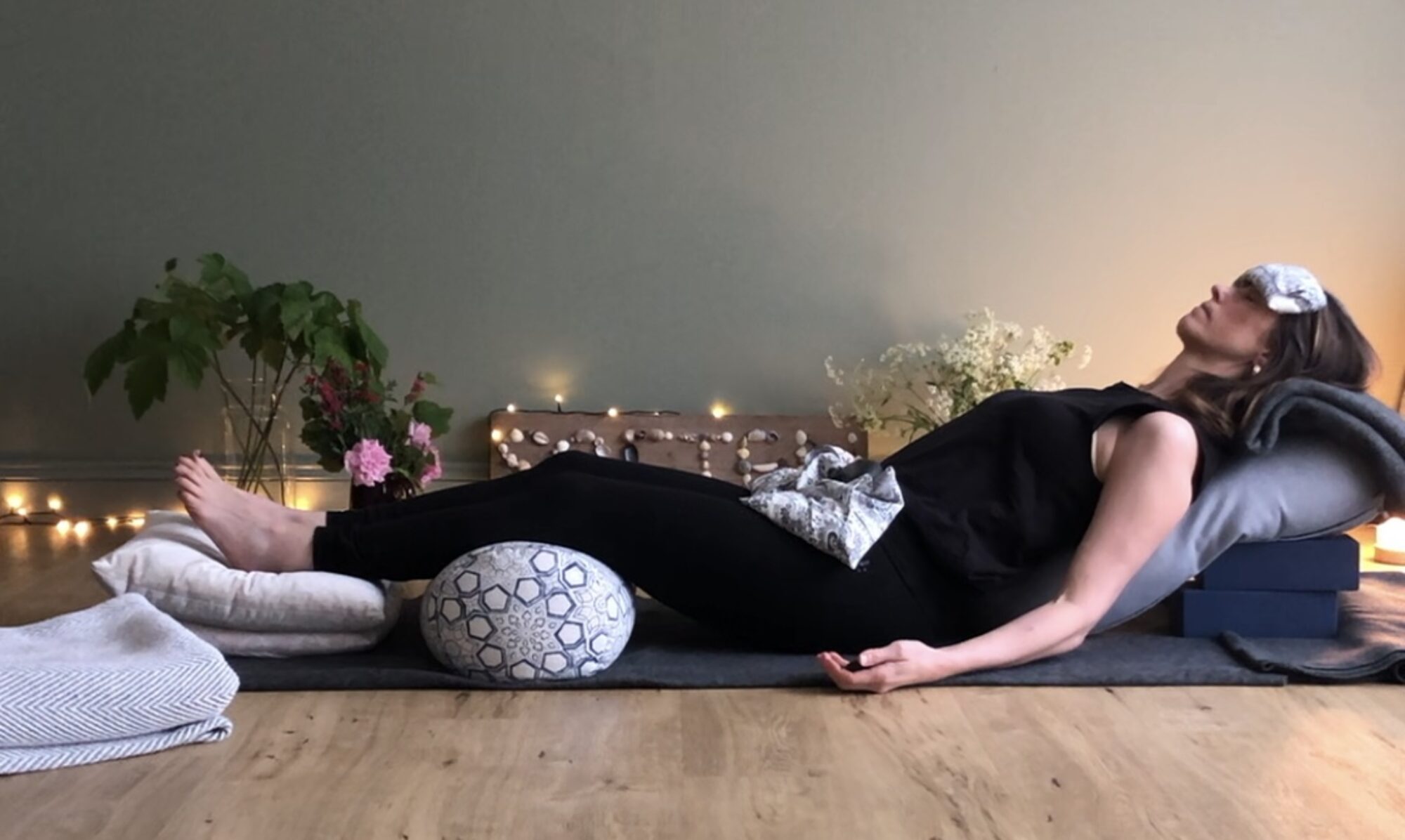
10pm (earlier if I can!): a 10 – 30 minute restorative practice. Usually this involves lying in one position, propped with all the supports (bolsters, weighted pillows, blankets, eye pillows). Just being. Just resting. Letting the day drain away before I even get in bed.
Why women struggle with this
I want to say something honest here, because I think it’s important.
Most women find intentional self-care genuinely difficult — not logistically, but psychologically. There is something in the way many of us were raised that makes it very hard to prioritise ourselves without a qualifier. Without thinking, ‘I deserve this because I’ve been working so hard’. Without ‘I’m doing this so I can be better for everyone else’. Without the guilt that sits alongside any act of self-attention, quietly asking: but shouldn’t you be doing something for someone else right now? Read my blog here on why I think resting is the opposite of lazy.
The trouble with needing a justification is that the justification can always be argued with. There is always more to do. There is always someone who needs something. There is always a reason why now isn’t quite the right time.
Intentional self-care requires something more radical than a justification. It requires a belief — a genuine, embodied belief, not just an intellectual one — that you matter. Not because of what you produce or who you support or how well you hold things together. But simply because you are a person, with a body and a nervous system and a life, and that is enough.
This is, for many women, the actual work. And it is work worth doing.
What the body is trying to tell you
Long before the mind registers burnout, the body is already leaving messages.
The shoulders that never fully drop. The jaw you find clenched in the middle of an ordinary conversation. Or wake up with an ache in your face, having ground your teeth all night. The tiredness that isn’t fixed by sleep. The low-grade anxiety that hums underneath the surface of days that should, by most measures, be fine. The way your body braces slightly — holds slightly — almost all of the time, as though it is perpetually waiting for the next thing to manage.
These are not character flaws. They are physiological responses to sustained stress and insufficient recovery. The nervous system, when chronically activated, begins to operate from a narrowed window — less capacity for joy, for creativity, for ease, for genuine connection. More reactivity. More flatness. More of that particular exhaustion that isn’t about hours of sleep but about being, for too long, too much in the mode of doing and not enough in the mode of being.
The body knows. It has always known. Most women I work with tell me, at some point, that they have known for a long time that something needed to change. They just haven’t had the space, or the permission, or the support, to begin.
What intentional self-care actually looks like
It doesn’t have to be dramatic. In fact, the most sustainable version of it rarely is.
It looks like a weekly yoga class in Oxford that you protect in your diary the way you protect a work meeting — not because it’s serious and effortful, but because it matters and it’s yours. Movement that isn’t about burning calories or improving performance but about coming back into your body, releasing what the week has deposited there, remembering what it feels like to be at home in yourself.
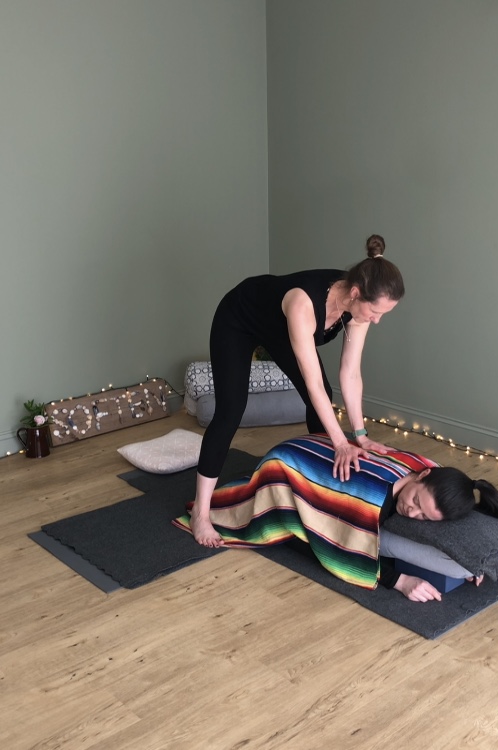
It looks like a regular massage appointment — and I mean regular, not occasional. Not when your back finally gives out. Not as a birthday treat. But as maintenance. As the consistent, skilful attention to a body that is working hard and deserves to be cared for. Massage, like deep rest yoga nidra and restful, restorative yoga, does things that nothing else quite replicates: it shifts the nervous system into a genuinely restorative state, releases tissue that has been chronically held, and creates a particular quality of rest — receptive, passive, held — that most women almost never experience in ordinary life.
It looks like paying attention to what you eat — not in the anxious, restrictive way that the wellness industry often promotes, but with genuine curiosity and care. Food is information for your body. It shapes your hormones, your energy, your mood, your capacity to handle stress. Small, sustainable changes made with understanding have a cumulative effect that can be quietly transformative, particularly for women navigating the hormonal shifts of midlife.
And sometimes it looks like something more immersive — a half-day, a morning, a real pause. Time specifically held for you to slow down enough to hear yourself. To ask the questions that get drowned out by the noise of ordinary life. What am I carrying? What do I actually need? What am I turning towards?
These aren’t luxuries. They’re necessary for living a fullsome and enjoyable, sustainable and well lived life. And the women who make space to ask them — and to sit with the answers — tend to move through the world differently afterwards.
The ripple effect
Here is something I have observed again and again in my work with women: when a woman begins to genuinely care for herself — not reactively, not guiltily, not in the cracks between everything else, but intentionally, as a practice — it changes everything around her too.
Not because she becomes more productive or more useful to others, although that sometimes happens. But because she becomes more present. More spacious. More able to give from a place of genuine abundance rather than thinly stretched obligation. The quality of her attention to her children, her relationships, her work — it shifts. And the permission she gives herself seems, almost magnetically, to give other women around her permission too.
Well-rested, well-nourished, genuinely cared-for women are not a wellness industry fantasy. They are a different kind of force in the world. And I believe — I really do believe this — that the work of supporting women to be that is some of the most important work there is. Which is why I love working with you. Why I ask you to recommend me and tell your friends. I genuinely believe we can create small shifts in the fabric of society through women being well rested, well resourced, in touch with their needs – through intelligent self care.
Where to begin
If you’ve read this far (thank you!), you’ve probably recognised something needs to change.
Maybe you’re already practising intentional self-care and this has named something you’ve been living but not quite articulating. Maybe you’re somewhere in the middle — doing some of it, feeling the pull towards more, but not quite sure where to start or whether you’re allowed to.
Or maybe you’ve been running on empty for a while, and you know it, and something about reading this has made that very clear.
Wherever you are: you don’t have to overhaul everything. You just have to begin somewhere. One class. One appointment. One honest conversation with yourself about what you actually need. Read about all my offerings here and watch yourself, feel yourself, begin to soften.
